A complete fountain lighting submittal should allow a contractor or consultant to verify three things before approval: the fixture meets the project's technical requirements, the installation is compatible with the fountain system, and the manufacturer can provide the required documentation and testing evidence.
For submersible LED lights for fountains, reviewing only wattage, color, and IP rating is not sufficient. A proper submittal should cover fixture construction, electrical characteristics, underwater protection, mounting, cabling, controls, photometric performance, materials, certifications, testing, warranty, and manufacturer information.
For contractors, a structured checklist reduces installation and coordination problems. For consultants, it provides a consistent basis for technical approval and comparison between suppliers.
At minimum, the submittal package should identify the exact fixture being proposed and provide enough technical information to compare it against the project specification.
A typical package should contain:
Product data sheet
Technical specification
Dimensional drawing
Installation details
Electrical data
Photometric information
Material specifications
IP or ingress-protection documentation
Control-system information
Cable and connector details
Testing documentation
Certifications where required
Warranty information
Manufacturer profile and relevant project references
The submitted model number should remain consistent across all documents. If the datasheet identifies one model while the drawing or quotation references another, the consultant should request clarification before approval.
For water feature LED lights, the submittal should also identify the intended application, installation depth, water environment, and mounting arrangement. This prevents a general-purpose fixture from being approved for an application requiring continuous underwater operation.
The technical data should be reviewed against the project's lighting schedule rather than evaluated independently.
Important parameters include:
| Parameter | What to Verify |
|---|---|
| Fixture type | Underwater fountain application |
| LED source | Manufacturer and LED configuration |
| Rated power | Actual fixture consumption |
| Input voltage | Match project electrical system |
| Light output | Suitable for the intended water effect |
| Beam angle | Match lighting design |
| Color temperature | Match project requirements |
| Color rendering | Verify where specified |
| RGB/RGBW | Confirm control and color configuration |
| Operating temperature | Suitable for installation environment |
| Fixture dimensions | Compatible with mounting location |
| Weight | Suitable for supporting structure |
| Cable length | Match installation requirements |
| Control protocol | DMX or specified system |
The consultant should pay particular attention to whether the stated wattage refers to LED power or complete fixture power. These values are not always identical.
Similarly, lumen output should not be compared without understanding the measurement conditions and optical configuration. Underwater lighting performance depends strongly on beam distribution and target geometry.
For submerged fixtures, ingress protection is a fundamental approval criterion, but an IP rating should not be reviewed in isolation.
The submittal should identify the fixture's IP rating and, where relevant, the conditions under which that rating was tested. For submersible LED lights for fountains, the sealing construction should also be documented.
Review:
Housing sealing method
Lens-to-housing gasket
Cable entry
Cable gland
Connector protection
Potting or encapsulation
Maximum installation depth
Applicable immersion conditions
Housing material
Fastener material
An IP68 designation does not establish one universal immersion depth for every product. The manufacturer should provide the applicable test or installation conditions.
For consultants, this distinction is important when the fountain design involves deep basins, continuous immersion, treated water, or saltwater exposure.
The electrical section should allow the contractor to confirm that the lighting system can be integrated into the project's power distribution.
The submittal should state:
Input voltage: Specify the actual operating voltage, such as 12V DC, 24V DC, or another required configuration.
Power consumption: Provide fixture-level wattage and total connected load.
Power supply: Identify compatible drivers, transformers, or power supplies where applicable.
Cable: State cable type, conductor size, standard length, and optional lengths.
Protection: Identify relevant electrical protection requirements.
Grounding and isolation: Provide the manufacturer's requirements for the installation.
Cable length deserves particular attention. Long runs can produce voltage drop, potentially affecting brightness, color consistency, or fixture operation. The contractor should therefore verify cable sizing against actual circuit distances rather than relying solely on the nominal fixture voltage.
A fountain-light submittal should demonstrate that the proposed fixture can achieve the intended visual effect.
Beam angle should correspond to the water feature being illuminated. Narrow optics may be suitable for concentrated jets, while wider optics can be more appropriate for water curtains, broad sprays, or cascades.
Photometric information is especially useful for large commercial projects. Depending on the project requirements, the manufacturer may provide:
Beam-angle information
Candela distribution
Illuminance data
Photometric files
Lighting simulation data
Optical diagrams
The review should consider fixture position, target distance, water trajectory, and viewing angle together.
Simply substituting a fixture with the same wattage does not guarantee equivalent lighting performance.
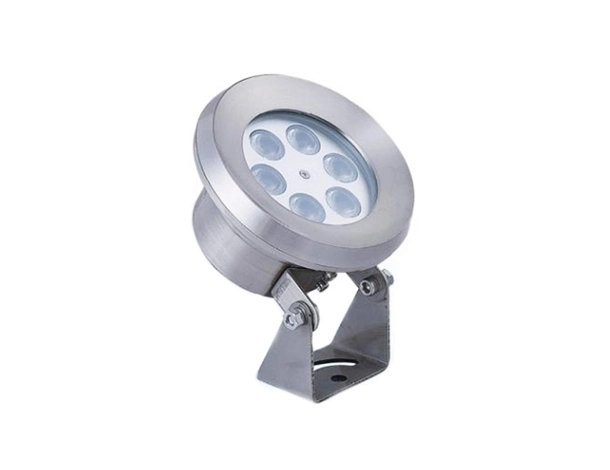
The fixture must physically integrate with the fountain structure.
The submittal should include dimensional drawings showing:
Overall fixture dimensions
Mounting-hole pattern
Bracket dimensions
Cable exit location
Required clearance
Installation orientation
Mounting hardware
Adjustment range
For retrofit or replacement projects, these dimensions are particularly important because existing mounting brackets may have fixed hole patterns or limited installation space.
The contractor should also confirm whether the proposed water feature LED lights require special brackets, underwater junction boxes, conduits, or installation accessories that are not included in the fixture price.
A complete submittal should make the installation interface clear enough for coordination with the fountain contractor and electrical contractor.
If the fountain uses dynamic lighting, control compatibility should be reviewed before approval.
For DMX-controlled fixtures, the submittal should identify:
Control protocol
DMX channel count
DMX operating modes
Addressing method
RGB/RGBW configuration
Maximum recommended signal arrangement
Required termination
Compatible controllers
Power and signal separation requirements
The controller schedule and fixture schedule should use consistent model numbers and channel information.
For large installations, the consultant may also require a DMX addressing schedule or control-zone diagram showing how individual fixtures correspond to fountain zones.
This is particularly important where lighting needs to synchronize with pumps, valves, music, or other show-control equipment.
Material selection should correspond to the fountain's actual water environment.
The submittal should identify the materials used for the main housing and externally exposed components, including:
Stainless steel grade
Lens material
Mounting brackets
Fasteners
Cable glands
Connectors
Other exposed metal components
304 stainless steel may be suitable for many freshwater applications, while 316L is generally preferred where chloride exposure, saltwater, or more aggressive conditions are expected.
The consultant should avoid approving a fixture based only on the housing material. A 316L housing does not eliminate corrosion risk if other exposed components are poorly selected or galvanically incompatible.
For demanding installations, the supplier should provide a clear statement confirming material suitability for the specified water chemistry.
Testing documentation provides evidence that the proposed fixture has been evaluated against relevant performance requirements.
Depending on the project and jurisdiction, the submittal may include:
IP testing documentation
Electrical safety certification
EMC-related documentation
Product test reports
Factory inspection records
Photometric test data
Material documentation
Quality-control records
The exact certification requirements should follow the project specification and applicable local regulations.
Consultants should also distinguish between a manufacturer's declaration and an independent test report. Where a project specification requires third-party certification or specific testing standards, the submitted documentation should demonstrate compliance with those requirements.
Supplier capability is part of the technical review, particularly for large or customized fountain projects.
When comparing led fountain light manufacturers, contractors and consultants should examine:
| Supplier Factor | What to Check |
|---|---|
| Manufacturing capability | In-house production and assembly |
| Product range | Different fountain applications |
| Customization | Voltage, cable, optics, housing options |
| Quality control | Factory inspection and testing |
| Technical support | Engineering and commissioning assistance |
| Documentation | Complete and consistent submittal package |
| Project experience | Relevant commercial installations |
| Warranty | Coverage and claim conditions |
| Replacement support | Availability of spare fixtures/components |
| Export capability | Packaging and international project support |
A manufacturer that can provide detailed drawings, consistent product documentation, testing evidence, and engineering support generally presents lower coordination risk than a supplier offering only a basic product datasheet.
The following checklist can be copied into a project review sheet.
| Review Item | Status |
|---|---|
| Correct fixture model identified | ☐ |
| Product datasheet submitted | ☐ |
| Fixture dimensions verified | ☐ |
| Mounting details submitted | ☐ |
| Rated voltage confirmed | ☐ |
| Fixture wattage confirmed | ☐ |
| Cable specification confirmed | ☐ |
| Cable length verified | ☐ |
| IP rating documented | ☐ |
| Immersion conditions confirmed | ☐ |
| Housing material verified | ☐ |
| Corrosion resistance reviewed | ☐ |
| Lens and gasket construction reviewed | ☐ |
| Beam angle confirmed | ☐ |
| Photometric data submitted | ☐ |
| Color specification confirmed | ☐ |
| DMX/control compatibility verified | ☐ |
| Power-supply requirements confirmed | ☐ |
| Factory testing documented | ☐ |
| Required certifications submitted | ☐ |
| Warranty provided | ☐ |
| Manufacturer information provided | ☐ |
| Installation instructions provided | ☐ |
| Relevant project references available | ☐ |
Using this checklist before approval can identify technical gaps while changes are still inexpensive to make.
A fountain lighting submittal should demonstrate more than basic product compliance. It should give contractors and consultants enough information to verify performance, installation compatibility, underwater durability, electrical integration, control compatibility, and supplier capability.
For submersible LED lights for fountains, particular attention should be given to immersion conditions, sealing construction, cable systems, materials, and testing documentation. For water feature LED lights, beam angle, photometric performance, mounting geometry, and control architecture should be reviewed against the actual fountain design.
A well-prepared submittal also makes it easier to compare led fountain light manufacturers on technical capability rather than price alone, reducing the risk of installation changes, control-system conflicts, premature failures, and commissioning delays.
Typically, it includes product data, drawings, electrical information, photometric data, installation details, certifications, testing documents, and warranty information.
Not by itself. The applicable immersion depth, sealing construction, cable entry, and testing conditions should also be verified.
Yes. Beam angle directly affects illumination coverage and should match the fountain's water pattern and fixture position.
Verify the fixture model, dimensions, voltage, wattage, mounting method, IP rating, cable configuration, and control compatibility.
It helps consultants assess production capability, quality control, technical support, warranty service, and relevant project experience.
It depends on the water environment. 304 can suit many freshwater applications, while 316L is generally more appropriate for chloride-rich or saltwater conditions.

 +86-17378775697
  English