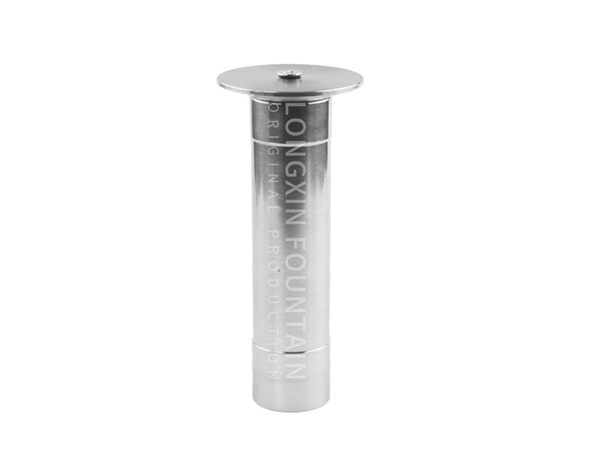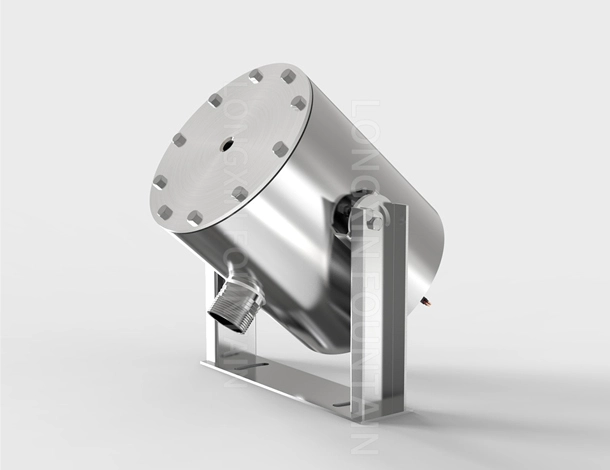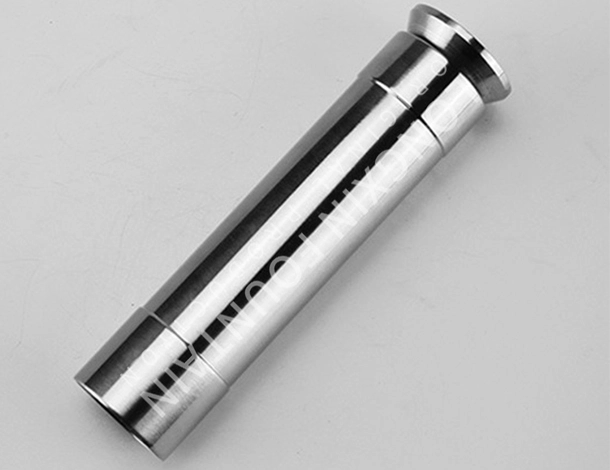
A commercial fountain lighting layout should be designed from the intended visual result backward. Beam angle determines how widely the light spreads, spacing determines how evenly fixtures overlap, and the visual target determines where the highest light intensity should fall. For an underwater fountain light, simply installing more fixtures rarely produces a better result; incorrect beam selection can create hot spots, dark gaps, excessive glare, or poor illumination of the water pattern.
For projects evaluating LED Water Fountain Lights, the lighting plan should consider nozzle type, water trajectory, viewing distance, fixture position, water depth, beam angle, fixture output, and the desired appearance of the fountain at night. fountain lights for sale should therefore be compared based on optical performance and layout suitability rather than wattage alone.
The appropriate beam angle depends primarily on the distance between the fixture and the visual target.
A narrow beam concentrates light into a smaller area and is useful when the fixture is relatively far from the target or when a defined jet needs to be highlighted. A wider beam distributes light over a larger area and is more suitable for broad sheets, shallow water features, or targets positioned close to the fixture.
Typical applications can be approached as follows:
| Beam Angle | Typical Application |
|---|---|
| Narrow | Tall jets, focused water columns, distant targets |
| Medium | Standard vertical jets and medium-width water patterns |
| Wide | Water curtains, sheets, broad spray patterns |
| Very wide | Shallow pools and large nearby surfaces |
The actual result depends on optical design and fixture output, so beam angle should never be evaluated independently from luminous intensity.
For an underwater fountain light, the fixture's position relative to the nozzle is equally important. A narrow beam aimed incorrectly can illuminate only part of a jet, while a wider beam positioned too close to the nozzle can create unnecessary spill light.
There is no universal spacing distance for commercial fountains. Spacing should be calculated from beam spread, fixture output, target dimensions, and the visual uniformity required by the design.
A practical starting point is to determine the width of the illuminated area at the target plane. For a beam angle θ and target distance D, the approximate beam diameter can be estimated as:
Beam Diameter ≈ 2 × D × tan(θ/2)
This provides a useful first estimate for fixture spacing. However, fixtures should generally have controlled overlap rather than being spaced exactly at the edge of each beam.
For example, if a medium beam illuminates a relatively narrow water jet, fixtures can be positioned to create overlapping pools of light. This reduces visible dark zones as the water moves or changes shape.
Spacing should also account for the actual fountain geometry. Circular fountains may require fixtures arranged radially around a basin, while linear water walls require a continuous row with consistent optical orientation.
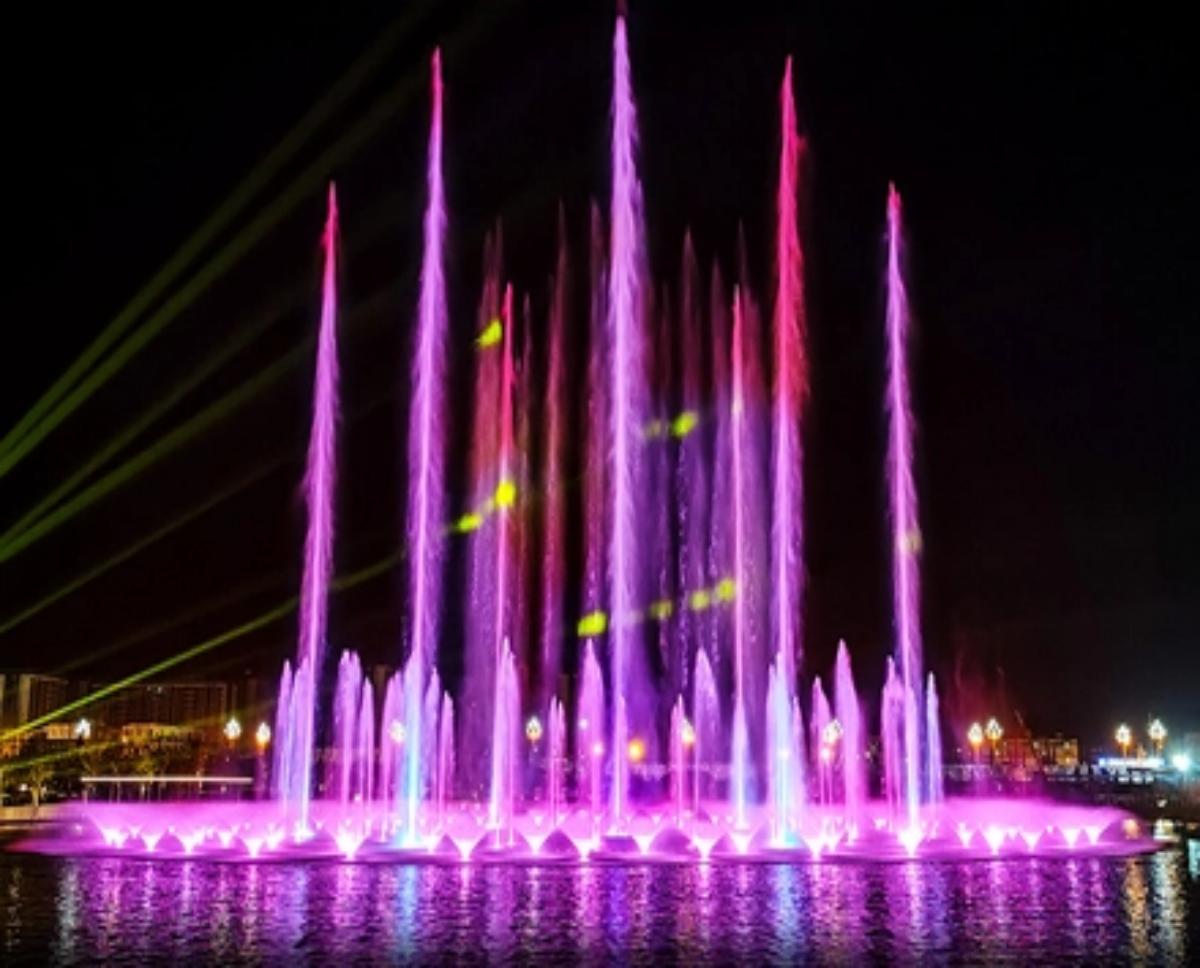
Fixture position should follow the water pattern rather than simply the physical location of the nozzle.
For vertical jets, the light is commonly installed near the nozzle and aimed upward along the water trajectory. The objective is to keep the beam aligned with the main body of the jet while minimizing direct glare toward spectators.
For larger water features, an offset position may provide better coverage than placing the fixture directly beneath the nozzle. This can be useful when the water pattern has a curved trajectory or when several streams need to be illuminated from a controlled viewing direction.
Installation depth also affects the optical result. Water, lens material, and the angle between the fixture and water trajectory all influence how much useful light reaches the target.
The lighting plan should therefore show both fixture coordinates and aiming direction, rather than specifying fixture locations alone.
Different fountain effects require different optical strategies.
Vertical jets often benefit from narrow or medium beams that follow the water column. The fixture should be aligned with the jet to create a continuous illuminated appearance.
Fan-shaped sprays usually require wider coverage. Multiple fixtures may be used to distribute light across the complete water pattern without creating excessive brightness at its center.
Water curtains require relatively broad and even illumination across a linear plane. Fixture spacing and beam overlap are especially important because uneven spacing can produce visible bright and dark sections.
For waterfalls and cascades, the lighting target is often the moving water surface rather than a narrow jet. Wider optics or carefully angled fixtures can provide more uniform coverage.
This is why a single beam-angle specification is not sufficient for a commercial project. The optical configuration should be selected according to the fountain's hydraulic effect.
Hot spots generally occur when fixture intensity is concentrated too heavily on a small portion of the water. Dark areas occur when the beam coverage is too narrow, fixtures are spaced too far apart, or the fixtures are poorly aimed.
Three adjustments are particularly effective:
Adjust beam angle. A wider optic can improve coverage when the target is close to the fixture.
Modify fixture spacing. Increasing overlap can smooth transitions between adjacent illuminated areas.
Reposition or re-aim fixtures. Even a suitable optic can produce uneven illumination if the fixture is not aligned with the actual water trajectory.
For LED Water Fountain Lights, optical uniformity should be assessed from the primary viewing positions, not only from directly above the fountain. A layout that appears balanced from one angle may reveal hot spots or dark gaps from another.
Commercial fountains are often viewed from multiple locations, so glare control should be part of the lighting layout from the beginning.
Fixtures should be positioned and aimed so that the light source itself is not unnecessarily visible to spectators. This is particularly important for high-output underwater fountain light fixtures installed in shallow basins.
The designer should identify:
Primary viewing areas
Secondary viewing areas
Typical viewing distances
Eye-level sight lines
Reflective architectural surfaces
Nearby pedestrian circulation
Potential glare from exposed lenses
The visual target is the illuminated water, not the fixture. If spectators see intense points of light instead of the intended water effect, the layout needs adjustment even if the measured illumination is adequate.
When evaluating fountain lights for sale, buyers should compare the complete optical and installation specification rather than selecting fixtures based on price or wattage.
Important parameters include:
| Parameter | Why It Matters |
|---|---|
| Beam angle | Determines coverage and concentration |
| Optical intensity | Determines how strongly the target is illuminated |
| Fixture wattage | Affects power demand and output |
| Light source | Influences color quality and efficiency |
| Lens design | Affects beam distribution underwater |
| Housing size | Influences installation options |
| IP rating | Indicates ingress protection |
| Material | Affects long-term durability |
| Cable configuration | Affects installation and maintenance |
| Control system | Determines static or dynamic effects |
| Color options | Determines visual programming capability |
For large commercial projects, it is also useful to request photometric information or a lighting simulation. This allows the designer to compare different beam angles and fixture quantities before installation.
A professional lighting schedule should connect each fixture to a defined visual target.
A useful project specification can include:
| Design Item | Specification |
|---|---|
| Fountain zone | Identify hydraulic or architectural area |
| Water effect | Jet, spray, curtain, cascade, etc. |
| Fixture type | LED Water Fountain Lights |
| Fixture position | Coordinates or drawing reference |
| Mounting depth | Actual installation position |
| Beam angle | Selected optical distribution |
| Aiming angle | Direction toward visual target |
| Fixture spacing | Center-to-center distance |
| Color | White / RGB / RGBW as required |
| Control | DMX or other control system |
| Viewing area | Primary and secondary sight lines |
| Glare control | Required where applicable |
| Testing | Night-time aiming and visual inspection |
This format makes the lighting intent measurable and gives the installation team a clear reference during commissioning.
Commercial fountain lighting should be treated as an optical layout problem rather than a fixture-count exercise. Beam angle determines coverage, spacing determines continuity, and fixture position determines whether the light actually follows the intended water movement.
For an underwater fountain light, the best result comes from matching the optical distribution to the water effect and then refining spacing and aiming from the principal viewing locations. When comparing fountain lights for sale, buyers should also evaluate beam performance, optical intensity, installation depth, materials, control compatibility, and testing requirements.
A well-developed lighting plan produces a more coherent nighttime fountain display while reducing unnecessary fixture quantity, glare, uneven illumination, and commissioning adjustments.
 +86-17378775697
  English